Xinhua
05 Jun 2026, 15:18 GMT+10
by Xinhua writers Zhang Yunlong and Tian Ying
HANGZHOU, June 5 (Xinhua) -- As the Communist Party of China (CPC) approaches the 105th anniversary of its founding, around 80 journalists from China's major media organizations gathered in Jiaxing, east China's Zhejiang Province, to retrace the route taken by delegates to the Party's first national congress more than a century ago.
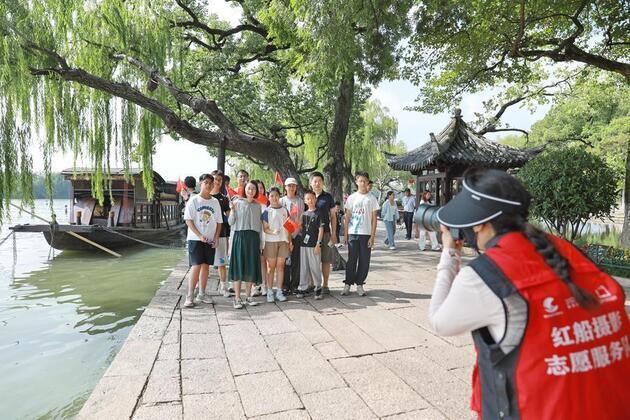
Their itinerary took them through key historical sites, including Jiaxing Railway Station, Shizihui Ferry and South Lake's central island, where the Red Boat, a 1959 replica of the boat used by congress delegates, is moored just offshore -- tracing the steps of the Party's founders while reflecting on how their ideals have shaped the country it leads today.
The vessel is one of the most recognizable symbols in modern Chinese history. It was here, in early August 1921, that the First National Congress of the CPC concluded with the adoption of the Party's first program and resolutions, marking the birth of a political party that would go on to transform China into a modern nation.
At the reconstructed Jiaxing Railway Station building, journalists learned how delegates attending the Party's first national congress traveled from Shanghai to Jiaxing by train in 1921. At Shizihui Ferry, they gathered where delegates are believed to have boarded a boat bound for South Lake. Like the delegates before them, the journalists also boarded a boat at the ferry site. Crossing the lake to the central island, they viewed the Red Boat moored nearby.
"When I boarded the boat to visit the Red Boat, I found myself thinking about the delegates who had worked for China's future all those years ago," said Wang Jiajun, a young journalist from Hangzhou, the provincial capital, who joined the profession last year. "Looking at the Red Boat, you can feel the weight of history."
Yet standing there, her thoughts turned not only to the past, but to how much had changed since.
"The biggest difference is that people today live much better lives," Wang said. "A century ago, many people were concerned with basic survival. Today, people think more about how to live better -- improving their quality of life, pursuing knowledge and embracing new technologies."
Under CPC leadership, China has grown from a poor and largely agrarian country into the world's second-largest economy, while making rapid advances in areas ranging from infrastructure and manufacturing to science and technology.
That contrast became even more apparent as the trip extended beyond the revolutionary sites to include research institutes, rural communities and technology facilities in Jiaxing.
At the Yangtze Delta Region Institute of Tsinghua University, Zhejiang, journalists learned how scientific research is being translated into industrial applications. Co-founded by Zhejiang Provincial Government and Tsinghua University, the institute has fostered the development and commercialization of a range of core technologies by Tsinghua-affiliated teams, including radiation-hardened, high-reliability power semiconductor chips.
In Sanxing Village in Nanhu District, peach orchards stretched across the village landscape. Journalists learned how local authorities and residents have developed specialty agricultural industries to promote rural revitalization.
At the "Light of Wuzhen" supercomputing center in Wuzhen Town, one of China's major supercomputing facilities and an emerging computing hub in the Yangtze River Delta, journalists stepped into a corridor lined with towering rows of computing equipment.
Near the entrance, a transparent demonstration unit offered visitors a glimpse of the facility's immersion-cooling technology. Computing modules sat submerged in a clear liquid with a boiling point of around 50 degrees Celsius, while streams of bubbles drifted upward as heat dissipated.
Wan Senlin, a solutions manager for China's national supercomputing network in Zhejiang, pointed to new energy technologies, semiconductors and intelligent robotics as areas where China has made notable progress in recent years.
He attributed China's steady economic and technological advances over the decades to the CPC's long-standing commitment to improving people's lives, combined with the hard work and determination of the Chinese people.
"It was my first visit to Jiaxing and my first time seeing the Red Boat," said Chen Xiaoyan, a Beijing-based journalist with more than two decades of experience. "At the South Lake Revolutionary Memorial Museum, you think about a group of young people more than a century ago, driven by ideals and determination, working under difficult conditions for what they believed was the future of the country."
In the exhibition, she paid particular attention to displays about industry and infrastructure. "It reminded me how underdeveloped the country once was," she said. "Then we left the memorial hall and visited cutting-edge research institutes and technology facilities. To see such enormous changes over a century was truly striking."
Today, the South Lake Revolutionary Memorial Museum attracts more than three million visitors a year, serving as an important venue for historical education and public reflection.
For the journalists retracing the Party's founding route, the trip was about more than commemorating a historical milestone. From the Red Boat on South Lake to peach orchards, research institutes and a supercomputing center, the journey in Jiaxing offered a glimpse of how China has traveled from revolution to modernization -- a transformation the Party set in motion more than a century ago aboard a small boat, and one that continues to unfold today.
Get a daily dose of Japan Herald news through our daily email, its complimentary and keeps you fully up to date with world and business news as well.
Publish news of your business, community or sports group, personnel appointments, major event and more by submitting a news release to Japan Herald.
More InformationBATHURST, Central West, NSW, Australia - Three teenagers have been before the courts this week following a violent car theft and subsequent...
TOKYO, Japan: Severe tropical storm Jangmi hit Japan on June 3, bringing strong winds and heavy rain that disrupted transport and businesses...
When a refrigerated freight train packed with fresh durians and mangosteens arrived at the Chinese rail station of Mohan after journeying...
SINGAPORE: The United States, the United Kingdom, and Australia are working together to build unmanned underwater vehicles under their...
BEIJING, China: China is stepping up efforts to expand the use of its digital yuan both domestically and internationally, according...
by Xinhua writers Zhang Yunlong and Tian Ying HANGZHOU, June 5 (Xinhua) -- As the Communist Party of China (CPC) approaches the 105th...
WASHINGTON, D.C.: The Trump administration has proposed new tariffs of 10 percent or more on imports from dozens of major U.S. trading...
NEW YORK, New York - U.S. stocks closed sharply higher on Thursday, led by a blockbuster rally in the Dow Jones Industrial Average,...
NEW YORK CITY, New York: Elon Musk's SpaceX is planning an unprecedented stock market debut, aiming to raise a record US$75 billion...
SAN FRANCISCO, California: Microsoft said it expects to have commercially useful quantum computers by 2029 after unveiling a new quantum...
LONDON, U.K.: Nigeria's Dangote refinery has built up a significant surplus of jet fuel and is well-positioned to supply markets around...
NEW YORK, New York - Wall Street suffered a dramatic sell-off on Wednesday as a new outbreak of hostilities in the U.S.-Iran conflict...